

For a large commercial brewery, CO₂ is not a by-product, it is a critical process gas. It carbonates beer, purges tanks, pressurises transfer lines, and protects product quality at every stage of production. Yet in most breweries, a significant portion of the CO₂ generated during fermentation is simply lost to the atmosphere before it can be recovered, compressed, and reused.
The financial and operational cost of this loss is substantial. CO₂ from the bulk supply market is expensive, supply can be volatile, and the environmental pressure to reduce industrial gas emissions is intensifying. For breweries operating at scale, a well-maintained CO₂ recovery system (anchored by a high-performance compressor) is no longer optional – it is a competitive necessity.
This guide examines where CO₂ losses occur in a commercial brewery, how your compressor sits at the centre of the recovery process, and what a disciplined maintenance programme looks like in practice.
During primary fermentation, yeast converts sugars into alcohol and CO₂. A standard lager fermentation produces approximately 4–5 kg of CO₂ per hectolitre of beer. In a brewery producing 500,000 hectolitres per year, that represents a theoretical yield of 2,000–2,500 tonnes of recoverable CO₂ annually.
In practice, however, recovery rates at many breweries fall between 70% and 85% of theoretical yield, even with a recovery system in place. The gap between theoretical and actual recovery is where your losses live, and where your costs accumulate.
Recovered CO₂ follows a well-defined pathway: fermentation vessels → foam separator → water scrubber → activated carbon purification → gas holder → CO₂ compressor → liquefaction → storage tank → point of use. Each transition in this chain represents a potential loss point. The compressor sits at the critical junction between low-pressure recovery and high-pressure storage, and its condition directly determines the efficiency of the entire system.
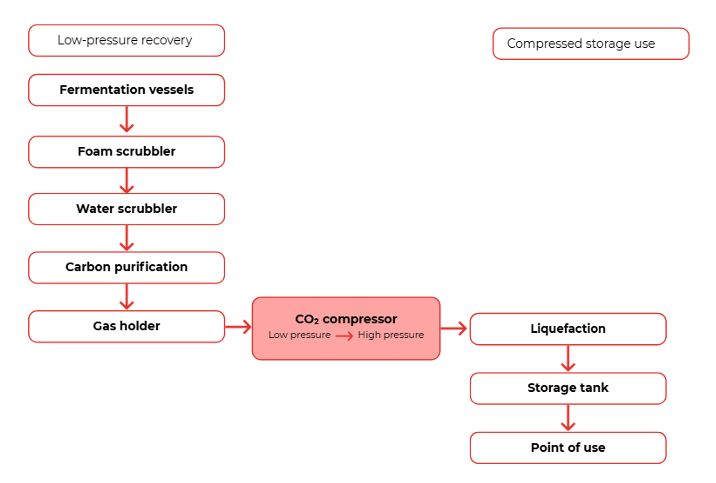
Understanding loss mechanisms is the first step toward eliminating them. The most significant sources of CO₂ loss in a large brewery fall into five categories.
Piston and diaphragm compressors rely on precision seals and valves to maintain compression efficiency. As these components wear, volumetric efficiency drops, discharge pressure becomes inconsistent, and gas leaks past the piston rings or diaphragm membrane. In a poorly maintained machine, this alone can account for a 5–15% reduction in effective recovery capacity.
Deferring scheduled maintenance is a common false economy. A compressor running past its service interval will typically operate at reduced efficiency long before any dramatic failure occurs. Valve seat wear, bearing play, and lubricant degradation all contribute to increasing power consumption and decreasing gas output – a combination that raises operating cost and reduces CO₂ yield simultaneously.
Inadequate purging protocols during system start-up and shutdown result in direct venting of recovered CO₂ to the atmosphere. This is particularly prevalent in systems where operators lack clear procedural guidance, or where instrumentation does not provide accurate purity feedback during the initial purge cycle.
Low-pressure CO₂ pipework between the fermentation hall and the compressor suction inlet operates at pressures close to atmospheric. Even minor gasket failures or valve seat wear in this section of the system allow CO₂ to escape without any visible indication at operating pressure. Leak detection surveys in this area are frequently overlooked because the consequences appear minor, but the cumulative losses over a full brewing cycle are significant.
If downstream storage capacity is undersized relative to compressor output, or if liquefaction performance degrades, liquid CO₂ tanks will vent excess pressure to the atmosphere via safety relief valves. This represents a direct loss of already-compressed, purified gas, and is among the most expensive loss mechanisms in the recovery chain.
In a brewery CO₂ recovery system, the compressor performs a demanding duty cycle. It draws fermentation gas at low suction pressures (typically in the range of 0.05 to 0.3 bar(g)) and compresses it to storage pressures of 18–25 bar(g), or higher if the system includes high-pressure buffer storage. The gas handled is moist, carries trace fermentation volatiles, and must not be contaminated by lubricating oil.
This combination of requirements (low suction pressure, high compression ratio, moisture tolerance, and oil-free operation) defines the engineering specification that a brewery CO₂ compressor must meet. Machines designed for general industrial gas service rarely satisfy all four criteria reliably over an extended operational life.
Oil-free piston and diaphragm compressors, operating in either single-stage or two-stage configuration depending on the required pressure ratio, are the technically correct solution. Their dry-running design eliminates the risk of oil contamination in the recovered gas stream, which is critical for beverage-grade CO₂ purity certification. Their robust mechanical architecture (suited to continuous duty at varying load conditions) makes them the standard of choice for commercial breweries worldwide.
A structured maintenance programme is the single most effective intervention available to reduce CO₂ losses and extend compressor service life. The following schedule reflects best practice for oil-free piston compressors operating in brewery recovery service.
Between scheduled service intervals, operators should treat the following conditions as indicators requiring engineering assessment without delay:
Rising discharge temperature at constant load and ambient conditions typically indicates valve inefficiency, internal leakage past piston rings, or cooling system degradation. Left unaddressed, elevated temperatures accelerate component wear and increase the risk of thermal overload.
Falling volumetric efficiency, evident by longer duty cycles, reduced gas throughput at constant pressure, or declining CO₂ purity from the recovery system, points to internal leakage within the compression stage.
Increasing power consumption at constant output is a reliable early indicator of mechanical wear, particularly in valve assemblies and piston ring sets, before any dramatic performance decline occurs.
Abnormal vibration signatures on cylinder heads, pipework, or the compressor frame indicate loose valve internals, broken valve springs, or developing bearing wear.
Frequent activation of safety relief valves on the discharge side may indicate downstream restriction, blocked cooler passages, or excessive compression ratio caused by control system faults.
Any of these conditions warrants immediate investigation. A compressor running in a degraded state does not simply consume more energy, it reduces the effective yield of your entire CO₂ recovery investment.
Not all CO₂ compressors are equal in the demands of brewery service. The combination of low suction pressure, variable gas composition during fermentation peaks, and the absolute requirement for oil-free operation creates a specification that only purpose-designed process gas machines can meet reliably.
Our manufacturing partner, Mehrer, the German manufacturer with origins dating to 1889, is the world’s leading manufacturer of oil-free piston and diaphragm compressors. Their machines are designed from the ground up for process gas applications in which gas purity, compression reliability, and long-term mechanical integrity are non-negotiable.
The Mehrer TRX series (available in single and two-stage configurations covering a range of flow capacities) is specifically engineered for CO₂ recovery applications in food and beverage environments. The oil-free crosshead design eliminates contamination risk, while the dry-running cylinder construction maintains gas purity from suction to discharge. The TRZ series extends this capability for higher-flow applications, and the TZW series is designed for installations requiring water-cooled inter-stage cooling in demanding continuous-duty cycles.
For breweries requiring high-pressure buffer storage of CO₂, the Mehrer MRX and MHX series offer compression to pressures up to 1,000 bar, enabling compact, high-density storage that reduces dependence on frequent external CO₂ deliveries.
The engineering consequence of specifying the right machine is measurable: reduced downtime, lower maintenance cost per operating hour, and (critically) a higher proportion of fermentation CO₂ captured, compressed, and returned to the production process rather than lost to the atmosphere.
SPRESS is the authorised distributor and service partner for Mehrer compressors across Africa. As specialists in high-pressure systems operating across the full range from standard industrial pressures to 1,200 bar, we bring the engineering depth that large-scale brewery CO₂ recovery demands.
Whether your requirement is a new CO₂ compressor installation, a performance assessment of an existing recovery system, scheduled preventative maintenance, or emergency repair of a machine already in service, we provide the full-service capability that keeps your recovery system operating at its design specification.
Our factory-trained team can service, repair, install, and maintain Mehrer CO₂ compressors and recovery systems, as well as any other high-pressure gas equipment across your brewery. We work directly with Mehrer’s engineering resources to ensure that spare parts, technical documentation, and factory-level support are available when your operation requires it.
CO₂ losses in your brewery represent a direct, quantifiable cost. A properly specified and correctly maintained compressor is the most effective single investment you can make to reduce that cost, improve process reliability, and demonstrate environmental responsibility to your stakeholders.
Contact our team for a technical consultation on your brewery CO₂ recovery system. We’ll assess your current equipment, identify your key loss points, and recommend the most cost-effective path to improving your recovery rate.
📞 +27 11 568 5257 📧 sales@spress.co.za 🌐 View our Mehrer CO₂ compressor range →
SPRESS: Africa’s High Pressure Experts